


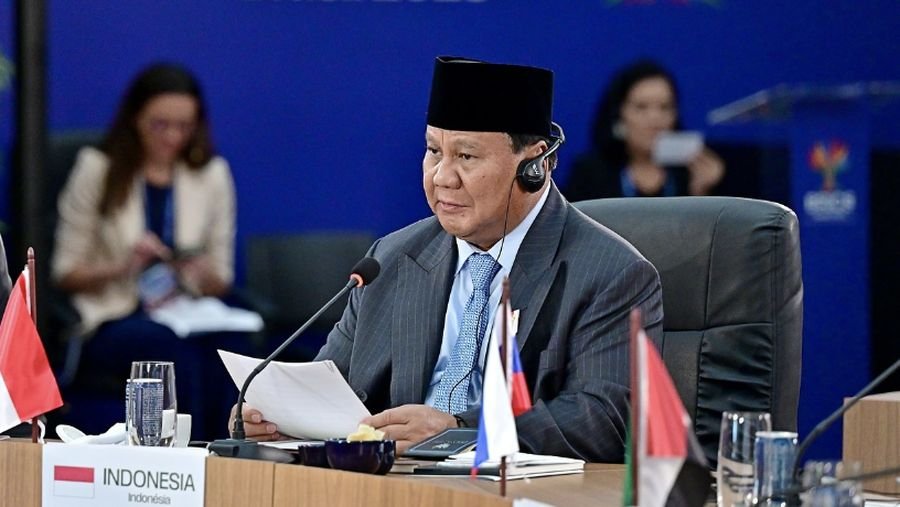
Foto: Sekretariat Presiden
Jakarta is accumulating partners faster than it is deciding what each relationship is for.
Indonesia’s foreign policy under President Prabowo Subianto can look contradictory. In August, Jakarta hosted the second Indonesia–China foreign and defence ministers’ 2+2 dialogue(Opens in new window), then held its tenth 2+2 meeting with Australia(Opens in new window) days later. In September, Prabowo travelled to Vladivostok as Vladimir Putin’s guest of honour at the Eastern Economic Forum(Opens in new window). Indonesia is also a BRICS member(Opens in new window), while continuing its OECD accession process(Opens in new window) and deepening economic and defence ties with Western partners.
Recent commentary in The Interpreter has described Indonesia’s course as “free and active drift”(Opens in new window) and, separately, as increasingly active but less free(Opens in new window). Those assessments identify real symptoms: mixed signals, growing external dependencies and uncertainty about the boundaries of cooperation.
But calling the result “drift” risks treating inconsistency as the starting point rather than the outcome. The more useful question is why a strategy designed to widen Indonesia’s room for manoeuvre can end up making its choices harder. Looking at the unevenness of Prabowo’s partnerships helps explain that paradox without assuming that engagement with several rival powers is itself a strategic failure.
Prabowo is still practising partial multialignment, engaging different powers for different purposes without committing Indonesia wholly to one bloc. But the practice has become uneven. Jakarta is accumulating relationships faster than it is deciding what each relationship is for.
Partial multialignment is not the same as equidistance. Indonesia can seek Chinese investment and industrial capacity, Western markets and defence technology, and Russian diplomatic and defence cooperation at the same time. BRICS membership does not require an anti-Western foreign policy, just as OECD accession does not require Indonesia to abandon its Global South identity.
The difficulty is that these relationships do not carry equal weight. China’s economic importance gives Beijing a form of influence that symbolic diversification cannot easily offset. Western relationships create another set of pressures. The February 2026 US–Indonesia reciprocal trade agreement(Opens in new window), for example, would eliminate tariffs on over 99% of US products entering Indonesia, while retaining a 19% US reciprocal tariff on most Indonesian goods, with exemptions for certain products.
Russia reveals another imbalance. Prabowo has invested considerable political attention in Moscow, while defence officials continue to explore military cooperation, training, and defence-industry links(Opens in new window). Yet Russia does not offer Indonesia the economic scale of China or the same combination of market, technology and institutional access available through Western partners. Engagement with Moscow broadens Indonesia’s diplomatic portfolio, but it does not automatically balance the constraints generated elsewhere.
This is why I am less concerned with whether Prabowo is moving Indonesia towards “East” or “West” than with whether his government still has a clear hierarchy of interests. A foreign policy can engage everyone and still lose focus.
The Western dimension deserves particular scrutiny. Prabowo’s long-standing familiarity with Western defence establishments and his government’s expanding security relationships can be useful for military modernisation. But closer ties also create expectations about Indonesia’s strategic behaviour. The answer is not to describe Indonesia as captured by the West. It is to ask whether Jakarta is sufficiently clear about where cooperation ends and strategic obligation begins.
The same test should apply to China and Russia. Partial multialignment only preserves autonomy when Indonesia, rather than its partners, determines the limits of each relationship.
Domestic politics makes this harder. Prabowo’s foreign policy is highly presidential. That can produce speed and visibility, but a widening network of commitments requires stronger coordination, not merely more presidential diplomacy. Decisions involving trade, defence procurement, critical minerals, infrastructure and diplomatic positioning cannot be evaluated separately. A concession that appears advantageous to one ministry may constrain another part of government later.
This is where the apparent confusion in Indonesian foreign policy originates. The problem is not that Jakarta talks to too many countries. It is that the purposes of those engagements are not always ranked clearly enough. Diplomatic activity can therefore be mistaken for strategy: another summit, another partnership, another memorandum, another announcement.
Prabowo should preserve partial multialignment, but discipline it. Major agreements should be tested against three questions. What concrete Indonesian interest does the relationship serve? What dependency or expectation does it create? And can Jakarta reject that expectation later without paying a disproportionate price?
Indonesia also needs clearer non-negotiables. Sovereignty, control over critical infrastructure, freedom to choose defence suppliers, and the ability to maintain relations with competing powers should not be traded away for short-term diplomatic or economic gains. These are not anti-American, anti-Chinese or anti-Russian positions. They are the conditions that make Indonesia’s “free and active” – bebas-aktif – doctrine meaningful.
Indonesia therefore does not need to choose between East and West. Nor does it need equal distance from every major power. It needs to know which relationships are instruments, which are becoming constraints, and which national interests come first.
Strategic autonomy is not measured by how many doors Jakarta can open. It is measured by whether Jakarta still decides which doors to close.
Artikel ini pernah diterbitkan di The Interpreter, Lowy Institute, tanggal 22 September 2026
Sumber
Darono, Yakti P, 2026. “Prabowo’s partial multialignment is losing focus” [Online] In https://www.lowyinstitute.org/the-interpreter/prabowo-s-partial-multialignment-is-losing-focus [accessed on 9 Oktober 2026]

